Yeatman
Reading & Dyslexia
Research Program
Understanding the factors that contribute to differences in how children learn to read.
Reading & Dyslexia Research Program Publications ↓Lab
Brain Development &
Education Lab
Our mission is to both use neuroscience as a tool for improving education, and use education as a tool for furthering our understanding of the brain.
Brain Development & Education Lab Publications ↓Lab Mission
The overarching goal of our research is to understand the interplay between brain development, education, and learning outcomes — specifically in reading. By combining multimodal neuroimaging with tightly controlled educational interventions, we study how a child's unique pattern of brain development predisposes them to succeed or struggle in a given education program. Education personalized to an individual's neurobiology is a long-term vision and our immediate goal is to inspire a virtuous cycle between education and neuroscience. Research at the intersection of these two disciplines can propel new discoveries regarding how experience sculpts brain development and, hopefully, offer insights into learning differences that are applicable in the classroom.
Virtuous Cycle Between Education and Neuroscience
↑Education as a tool to understand how experience shapes brain development.
↓Neuroscience as a tool to understand learning differences
Plasticity & Learning
We combine state-of-the-art neuroimaging with intensive reading-intervention programs to understand how education sculpts the brain's reading circuitry. Our work has shown that a targeted intervention drives rapid, large-scale changes in white matter tissue properties that track a child's learning in real time — and we're now working to predict a child's learning trajectory from the structure of their reading circuitry, and to understand the long-term effects of that plasticity.
Currently funded by NIH NICHD R01HD095861 · NCT04323488
Mechanisms of Learning Differences
Rather than treating dyslexia as a single, homogeneous condition, we conceptualize it as the interaction between a combination of risk and protective factors — a multifactorial model. The long-term goal is to identify the mechanisms underlying an individual child's struggles, elucidate useful accommodations, and predict the optimal approach to education and intervention for that child.
Currently funded by NIH NICHD R01HD116845, 2025–2030
Quantitative Models of the Reading Circuitry
How does the literate brain recognize a word? We introduced the first computational model of the computations performed by word-selective visual cortex, then extended it to explain a striking fact about reading: the brain can only recognize a single word at a time, with attention acting as a gating mechanism. We continue to formalize these models and apply them to individual differences in learning.
Research-Practice Partnerships
Our lab has research partnerships with thousands of schools around the country representing a commitment to building bridges between research and practice. Rather than a one-way street from the lab to society, we envision our partnerships as a virtuous cycle — implementing ROAR brings the cutting-edge of assessment research to the classroom and keeps our research grounded in real-world problems, while what we learn from those partnerships feeds back into the science.
Yeatman Lab Publications
Meet the Lab
Lab Alumni
Open-Source Software
All of our software is developed under a collaborative open-source model and released on GitHub under an unrestrictive license, in service of the broader scientific community. Code and data to reproduce every published finding from the lab is released alongside the paper. Several of our packages are in active use by hundreds of researchers and clinicians.
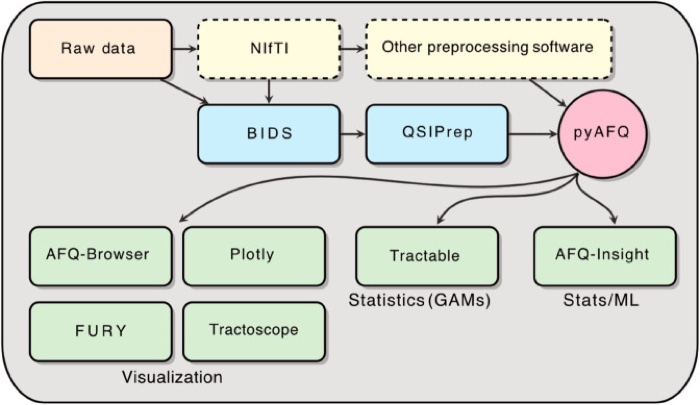
Three of these tools form a pipeline: pyAFQ turns raw diffusion MRI scans into automatically-identified white matter tracts, AFQ-Browser turns those results into an interactive website, and AFQ-Insight applies statistical learning to find which tract properties matter. Swipes for Science is a separate project for crowdsourcing quality control on imaging data.
pyAFQ
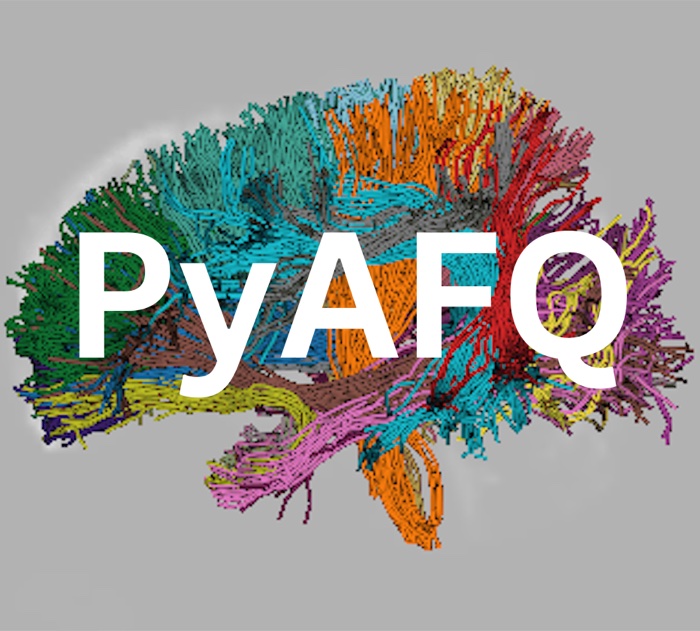
Automated Fiber Quantification in Python — an open-source, automated pipeline for brain tractometry, from raw diffusion MRI data (BIDS-compliant or not) through white matter tract identification and tissue-property quantification.
Cite: Kruper et al., 2025, PLoS Comp. Biology · Kruper et al., 2021, Aperture
AFQ-Insight
Statistical learning for tractometry data — applies machine learning and multidimensional statistics to pyAFQ output, helping researchers find which tract properties actually predict reading, cognition, or clinical outcomes.
AFQ-Browser — live demo
Turns a tractometry study into an interactive, sharable website. Rotate the brain, click a tract, and see how its properties vary along its length — and across every participant in the study. This is a real, live example browser.
This demo is interactive and works best on a larger screen — use "Open full screen" above.
Swipes for Science
GitHubA citizen-science game template that turns tedious manual quality-checking of brain scans into a quick swiping game, so any lab can crowdsource data annotation without writing app code. Braindr, the original live instance built on it, crowdsourced tens of thousands of real pass/fail ratings on individual brain slices from citizen scientists — like the gold-standard examples below. The same approach has since scaled into BrainSwipes, now used for quality control on two of the largest studies in the field, the NIH's ABCD Study and HBCD Study. Try the same pass/fail interaction on the left, and see Braindr's actual live participant leaderboard on the right.
Braindr's live leaderboard
Open full screen ↗This leaderboard is interactive and works best on a larger screen — use "Open full screen" above.
Building bridges from the lab to the classroom and back — inspiring a virtuous cycle between research and practice
ROAR — Rapid Online Assessment of Reading
A fully automated, online assessment platform grounded in our ongoing research. Rostered in 2,500+ schools and community organizations across 39 states — including as one of California's four approved dyslexia screening tools — with real-time score reports for teachers and no test administrator required.
Visit roar.stanford.edu ↗Figures from ROAR's norming & technical documentation ↗
In the Media
Join the Lab
We're an interdisciplinary team spanning education, pediatrics, psychology, neuroscience, and engineering — with openings for postdocs, students, and research staff. Open positions are coming soon.
Participate in Research
Families, schools, and adult readers help drive our work.
Sign up on the Reading & Dyslexia Research Program page →